
Two cats • One household, different benefit designs

Compare two-cat insurance by who uses the benefits

Price both cats together, but test the deductible and limit when one needs care and when both do. A shared account does not necessarily mean a shared policy.

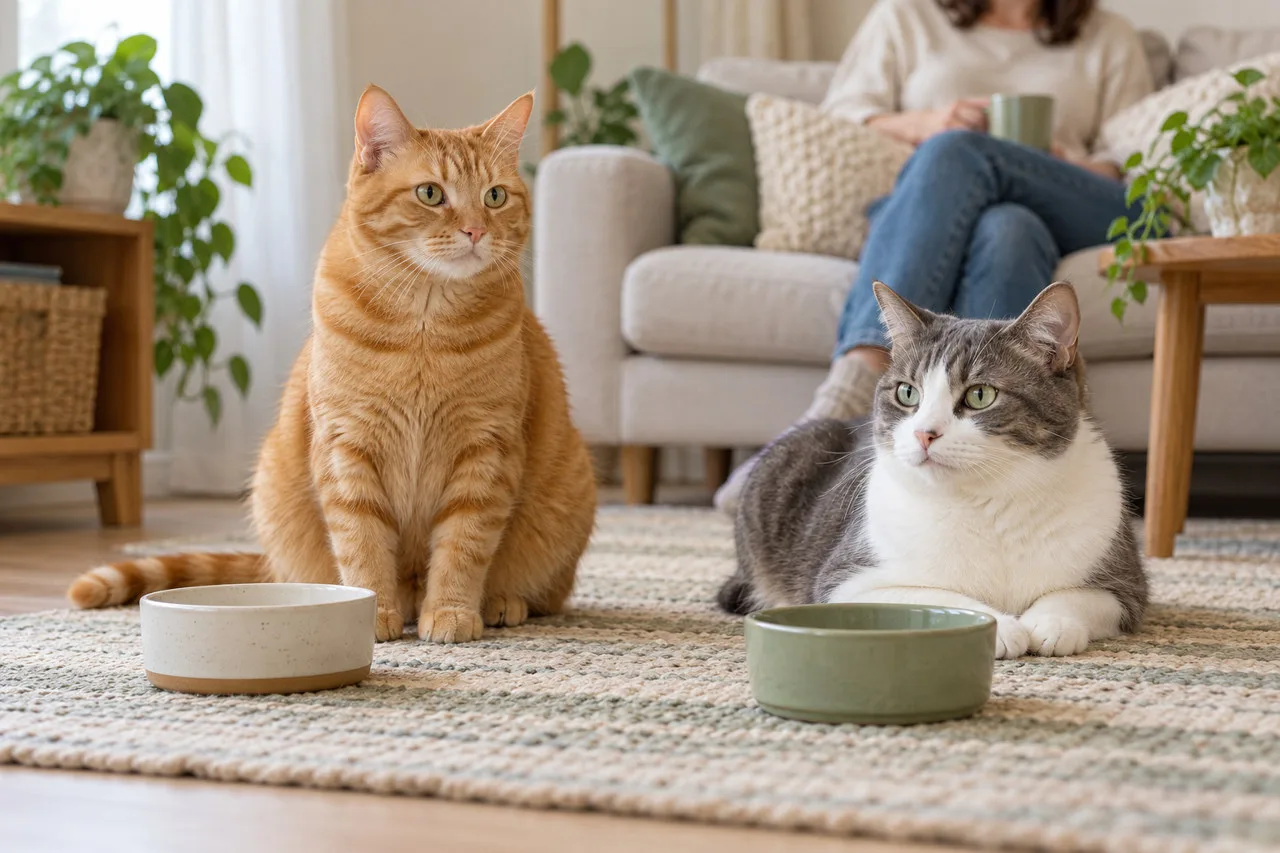
Two adult cats, one orange and one gray and white, resting near an owner at home
✓ Policy-first ✓ Independent ✓ Useful checks
Direct answer
For two cats, compare separate policies with any genuinely shared family-policy offer. Test both one-cat and two-cat claims before letting the combined premium or discount decide.
Cost & value

Identify the architecture before adding the prices

Arrangement Verified example Main trade-off to test
Shared family policy MetLife Pet describes up to three cats or dogs sharing a deductible, limit and reimbursement rate. Combined eligible expenses can reach the deductible, but claims draw on one benefit pool.
Separate providers A comparison option when each cat has a different suitable offer. More administration, potentially better continuity or fit for one cat.

The shared design is not merely a multi-pet discount on two policies. Ask the insurer to identify exactly where the deductible and annual limit apply. Also verify enrollment restrictions for both cats and the state; the product description does not establish that every household can obtain it.

No personalized two-cat quotes or claims tests were collected for this guide. The calculations below are deliberately fictional contract designs. They isolate the structure so you can ask insurers to repeat the exercise using their actual terms.

Pet profile

Run the same two cats through four scenarios

Assumed method: subtract the remaining deductible from eligible expenses, apply the insurer percentage, then cap the payment. Use this only when that matches the comparison you want to model. It cannot determine eligibility, a different formula order, service sublimits, or which cat receives a limited shared payment first.

Use expenses already judged eligible for this exercise. Excluded charges, routine care, fees not in the premiums and clinic-payment timing are outside the result. All defaults are fictional and can be changed. No data is sent or saved.

Cat A: individual offer
Cat B: individual offer
Shared offer for both cats

Enter your scenario and select Compare. The worked examples below also work without JavaScript.

Modeled cost = full annual premium + entered eligible expenses − modeled insurer payment. It is not all-in ownership spending or a guaranteed out-of-pocket maximum. Shared-plan output is the household total, not an allocation of payment to each cat.

What to know

First test: two modest eligible bills

Assume each cat has $400 of eligible expenses, an 80% reimbursement rate, and a deductible applied before that percentage. Compare a shared $500 annual deductible with separate $500 deductibles. Assume no earlier claims, enough remaining benefit and no other adjustments.

Fictional structure Deductible calculation Total insurer payment
One shared deductible ($400 + $400 − $500) × 80% $240
One deductible per cat Each $400 expense remains below its own $500 deductible $0

The shared deductible helps in this scenario because both cats contribute toward it. With just one cat’s $400 bill, neither design would pay under these assumptions. The result depends on how costs are distributed, not simply on having two cats.

Premiums are excluded from this small claim calculation. If the shared arrangement costs more to buy, include that difference before judging the household’s total expense.

Coverage

Second test: one cat uses most of the benefit

Now ignore deductibles and percentages by starting with amounts already calculated as payable before annual caps. Suppose Cat A has $7,000 in such payments and Cat B has $1,000. Compare one shared $10,000 cap with separate $5,000 caps for each cat.

Fictional structure Payments within the caps Amount blocked by the caps
Shared $10,000 pool $7,000 + $1,000 = $8,000 $0
Separate $5,000 per cat $5,000 + $1,000 = $6,000 $2,000 for Cat A

Both arrangements advertise $10,000 of total nominal household capacity, but they are not equivalent. The shared pool can accommodate one cat using more than half. Separate policies can protect one cat’s allocation from being consumed by the other.

For the opposite pressure test, suppose each cat has $7,000 in pre-cap payable amounts. Both designs above pay at most $10,000 in total. Under the shared arrangement, ask how remaining capacity is tracked as claims arrive; do not assume a reserved half for each cat. These are illustrative allocations, not predictions that either cat will become ill.

Cost & value

Add the household premium only after the benefit test

Collect the full-term price for each complete arrangement, including selected benefits and known fees. If a discount applies, use the actual payable total rather than multiplying a headline percentage by every item. MetLife’s materials distinguish the Family Plan from its individual-plan multi-policy discount; do not stack benefits the offer does not combine.

Consider a fictional shared arrangement costing $720 for the term and two individual policies costing $660 together. In the modest-bill example, the shared plan’s $240 payment exceeds its extra $60 premium by $180. With no eligible claims, the individual arrangement costs $60 less. Neither observation proves expected value because no claim probabilities have been assigned.

Repeat the test with unequal ages, benefits or histories only if those are the real cats’ inputs. Do not force identical settings for tidiness when one cat already has useful existing coverage or a different essential need.

Compare

An already insured cat can change the right comparison

If one cat is already insured for an ongoing condition, obtain the proposed replacement’s history treatment before moving it into a household arrangement. A new shared deductible is not valuable enough to erase an important exclusion by assumption. Keeping that cat’s existing policy and shopping only for the other may be the relevant alternative.

Keep records and invoices attached to the correct animal even under a shared plan. Sharing a benefit pool does not mean the cats share diagnoses. If both attend a clinic on the same day, request clear attribution of services and follow the insurer’s actual submission instructions.

For routine benefits, compare each cat’s anticipated services with its own applicable schedule. Do not infer that a shared medical limit means routine allowances are also freely transferable; ask how each component works.

Decision guide

Choose the arrangement that survives both tests

  • Can both cats enroll under the offered form, with their actual history disclosed?
  • What happens when only one cat has a large eligible course of care?
  • What happens when both cats use benefits in the same policy period?
  • What remains payable by the household before reimbursement?
  • Is the premium difference worth the specific trade-off you identified?

The answer may be a shared plan, two policies with one insurer or two different insurers. Write the reason in terms of benefit allocation, continuity and cost, not just “two cats get a discount.” That leaves a comparison you can revisit if a cat’s needs or the renewal terms change.

Evidence

Sources and policy context

These public references support the consumer or veterinary context. Named insurer details were checked in official product materials; the policy offered for your pet and state determines the actual terms.

Next step

Compare Current Pet Insurance Rates

Check current options for your pet and location, then compare the policy details, exclusions, costs, and eligibility before choosing.

Compare the policy before you choose Check the actual offer, exclusions and out-of-pocket terms.
See Rate Options